Published on Readora
The Best Business and Entrepreneurship eBooks for Beginners
Every successful entrepreneur starts with an idea. What separates those who build thriving businesses from those who never move beyond the planning stage is often knowledge. Behind many of the world's most successful founders, executives, and innovators is a library of books that shaped the way they think, solve problems, and make decisions.
The rise of digital publishing has made business knowledge more accessible than ever. Today, aspiring entrepreneurs can carry an entire business library on a smartphone, tablet, or laptop, learning from some of the brightest minds in entrepreneurship whenever and wherever they choose.
Whether you're planning to launch your first startup, grow an existing business, or simply improve your understanding of money, marketing, leadership, and innovation, building a strong reading habit is one of the smartest investments you can make.
At Readora.ng, business and entrepreneurship eBooks remain one of the fastest-growing categories because readers understand that learning never stops in business. Every new skill, strategy, or perspective has the potential to unlock the next level of success.
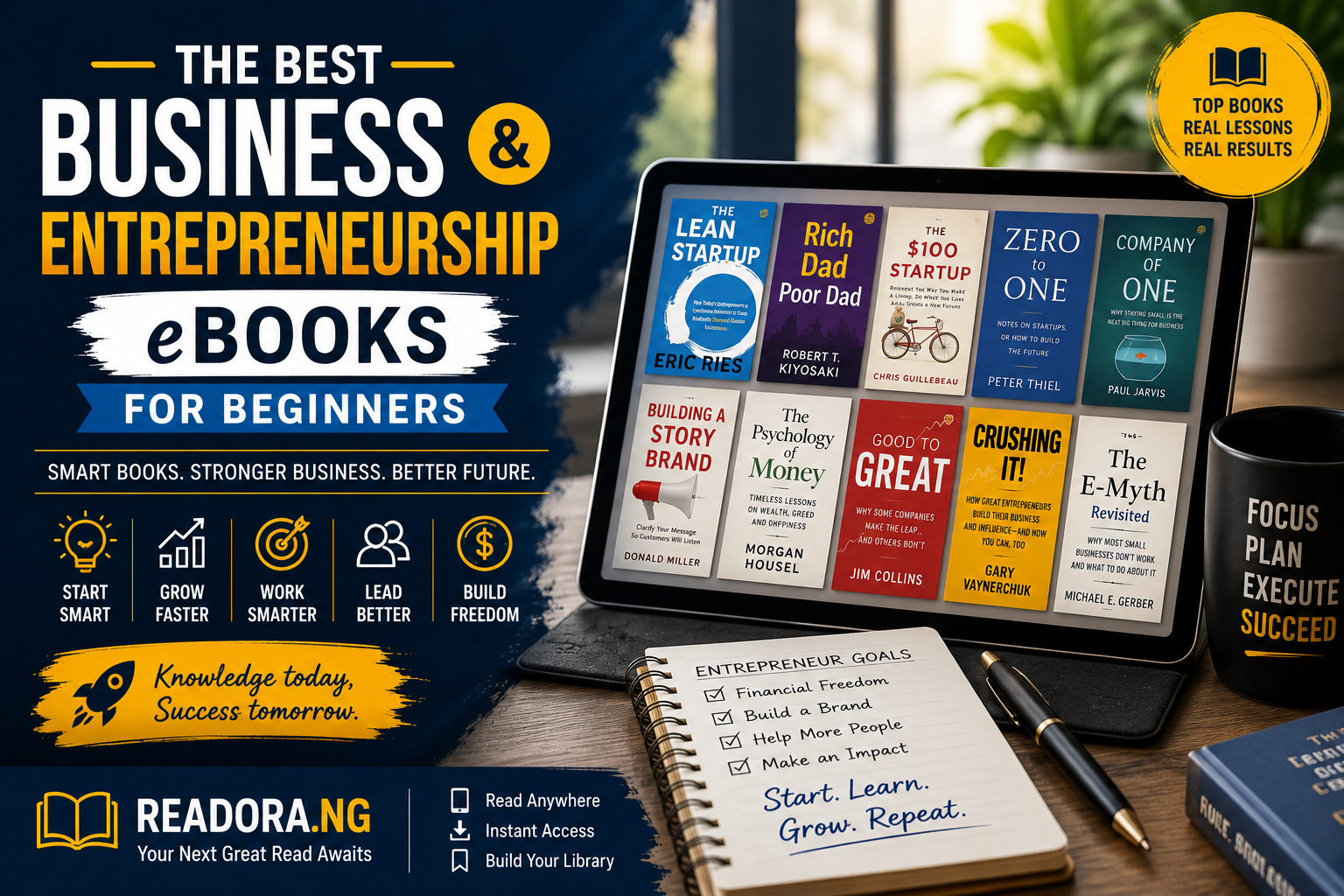
Here are some of the best business and entrepreneurship eBooks every beginner should consider adding to their digital library.
1. The Lean Startup by Eric Ries
Starting a business without understanding your customers can lead to wasted time, money, and effort. The Lean Startup introduces a smarter approach to entrepreneurship by encouraging founders to test ideas quickly, learn from customer feedback, and improve products through continuous iteration.
Rather than spending years developing a product behind closed doors, Eric Ries demonstrates how successful companies build, measure, and learn in rapid cycles. The principles in this book have influenced startups around the world and remain highly relevant for modern entrepreneurs.
Key lessons include:
Validating business ideas before investing heavily.
Building a Minimum Viable Product (MVP).
Learning from customer feedback.
Reducing unnecessary business risks.
2. Rich Dad Poor Dad by Robert Kiyosaki
Financial education is one of the foundations of successful entrepreneurship. Rich Dad Poor Dad challenges traditional beliefs about money and encourages readers to think differently about assets, liabilities, investing, and financial independence.
Although the book is often associated with personal finance, its lessons on wealth creation and financial mindset have inspired countless entrepreneurs to build businesses rather than relying solely on employment income.
3. The $100 Startup by Chris Guillebeau
Many aspiring entrepreneurs delay starting a business because they believe they need substantial capital.
The $100 Startup proves otherwise.
Drawing from real-life success stories, Chris Guillebeau demonstrates how individuals have built profitable businesses with minimal investment by focusing on skills, creativity, and solving real problems.
This book is particularly valuable for freelancers, side hustlers, and first-time business owners.
4. Zero to One by Peter Thiel
Creating something entirely new is one of the most challenging—and rewarding—forms of entrepreneurship.
In Zero to One, Peter Thiel encourages founders to build businesses that create unique value instead of simply competing in crowded markets.
The book explores innovation, competition, technology, and long-term thinking, offering readers a different perspective on building sustainable companies.
5. Company of One by Paul Jarvis
Growth is often celebrated as the ultimate measure of business success. Company of One questions that assumption.
Paul Jarvis argues that bigger isn't always better. Instead, he explores how entrepreneurs can build profitable, fulfilling businesses without constantly chasing expansion.
This refreshing perspective resonates with freelancers, consultants, creatives, and digital entrepreneurs who value flexibility alongside financial success.
6. Building a StoryBrand by Donald Miller
Great businesses communicate clearly.
One of the biggest reasons products fail isn't because they're poor quality—it's because customers don't understand their value.
Building a StoryBrand introduces a powerful communication framework that helps businesses simplify their marketing messages and connect with customers more effectively.
Every entrepreneur involved in branding, content creation, or digital marketing can benefit from its practical advice.
7. The Psychology of Money by Morgan Housel
Entrepreneurship involves making financial decisions every day.
The Psychology of Money explores why behavior often matters more than technical knowledge when it comes to building wealth.
Through engaging stories and timeless principles, Morgan Housel explains how patience, consistency, and emotional discipline influence financial success.
8. Good to Great by Jim Collins
Why do some companies remain average while others achieve extraordinary success?
Jim Collins spent years researching this question before writing Good to Great.
The book identifies common characteristics shared by exceptional companies, including disciplined leadership, strategic focus, and long-term thinking.
Many of its principles remain relevant for startups and established businesses alike.
9. Crushing It! by Gary Vaynerchuk
The internet has transformed entrepreneurship.
Crushing It! explores how personal branding, social media, and content creation have created opportunities for individuals to build successful businesses around their passions.
Readers interested in digital entrepreneurship, online marketing, or creator businesses will find plenty of inspiration throughout the book.
10. The E-Myth Revisited by Michael E. Gerber
Many small business owners become trapped working in their business rather than building systems that allow it to grow.
The E-Myth Revisited explains why successful businesses rely on repeatable processes rather than constant owner involvement.
It encourages entrepreneurs to think like business builders rather than employees, making it an essential read for anyone planning long-term growth.
Essential Skills Every Entrepreneur Should Develop
While great books provide valuable knowledge, lasting success depends on applying those lessons consistently. Entrepreneurs who continue learning often develop skills that help them adapt to changing markets and overcome new challenges.
Some of the most valuable skills include:
Financial management.
Communication and negotiation.
Leadership.
Marketing and branding.
Sales.
Customer service.
Time management.
Strategic thinking.
Problem-solving.
Decision-making.
Each of these skills can be strengthened through continuous reading and practical experience.
Why eBooks Are Perfect for Entrepreneurs
Business owners rarely have the luxury of uninterrupted free time. eBooks solve this challenge by making knowledge instantly accessible.
Whether waiting for a meeting, travelling, commuting, or taking a short break, entrepreneurs can continue learning without carrying physical books.
Digital libraries also make it easier to organize business resources, highlight important ideas, and revisit key concepts whenever needed.
This flexibility is one of the reasons business titles continue to be among the most popular categories on Readora.ng.
Frequently Asked Questions
Which business book should beginners read first?
The Lean Startup is an excellent starting point because it introduces practical concepts for building and validating business ideas before making major investments.
Can business books really improve entrepreneurship skills?
Yes. While no book guarantees success, many provide proven strategies, frameworks, and lessons drawn from experienced entrepreneurs and business leaders.
Should I read one business book at a time?
Reading one book at a time allows you to absorb and apply its ideas more effectively. Taking notes and implementing key lessons often produces better results than reading quickly without action.
Are eBooks suitable for business professionals?
Absolutely. Their portability allows busy professionals to continue learning during travel, breaks, or downtime, making them an ideal format for lifelong learning.
Final Thoughts
Entrepreneurship is a journey of continuous learning. Markets evolve, technologies change, and customer expectations shift, making ongoing education one of the greatest competitive advantages any business owner can have.
The books featured in this collection provide valuable insights into innovation, leadership, finance, marketing, productivity, and business growth. Whether you're launching your first venture or expanding an existing company, each title offers lessons that can help shape smarter decisions and stronger businesses.
Explore the growing collection of business and entrepreneurship eBooks on Readora.ng and start building the knowledge that powers successful ventures—one page at a time.
Every successful entrepreneur starts with an idea. What separates those who build thriving businesses from those who never move beyond the planning stage is often knowledge. Behind many of the world's most successful founders, executives, and innovators is a library of books that shaped the way they think, solve problems, and make decisions.
The rise of digital publishing has made business knowledge more accessible than ever. Today, aspiring entrepreneurs can carry an entire business library on a smartphone, tablet, or laptop, learning from some of the brightest minds in entrepreneurship whenever and wherever they choose.
Whether you're planning to launch your first startup, grow an existing business, or simply improve your understanding of money, marketing, leadership, and innovation, building a strong reading habit is one of the smartest investments you can make.
At Readora.ng, business and entrepreneurship eBooks remain one of the fastest-growing categories because readers understand that learning never stops in business. Every new skill, strategy, or perspective has the potential to unlock the next level of success.
Here are some of the best business and entrepreneurship eBooks every beginner should consider adding to their digital library.
1. The Lean Startup by Eric Ries
Starting a business without understanding your customers can lead to wasted time, money, and effort. The Lean Startup introduces a smarter approach to entrepreneurship by encouraging founders to test ideas quickly, learn from customer feedback, and improve products through continuous iteration.
Rather than spending years developing a product behind closed doors, Eric Ries demonstrates how successful companies build, measure, and learn in rapid cycles. The principles in this book have influenced startups around the world and remain highly relevant for modern entrepreneurs.
Key lessons include:
Validating business ideas before investing heavily.
Building a Minimum Viable Product (MVP).
Learning from customer feedback.
Reducing unnecessary business risks.
2. Rich Dad Poor Dad by Robert Kiyosaki
Financial education is one of the foundations of successful entrepreneurship. Rich Dad Poor Dad challenges traditional beliefs about money and encourages readers to think differently about assets, liabilities, investing, and financial independence.
Although the book is often associated with personal finance, its lessons on wealth creation and financial mindset have inspired countless entrepreneurs to build businesses rather than relying solely on employment income.
3. The $100 Startup by Chris Guillebeau
Many aspiring entrepreneurs delay starting a business because they believe they need substantial capital.
The $100 Startup proves otherwise.
Drawing from real-life success stories, Chris Guillebeau demonstrates how individuals have built profitable businesses with minimal investment by focusing on skills, creativity, and solving real problems.
This book is particularly valuable for freelancers, side hustlers, and first-time business owners.
4. Zero to One by Peter Thiel
Creating something entirely new is one of the most challenging—and rewarding—forms of entrepreneurship.
In Zero to One, Peter Thiel encourages founders to build businesses that create unique value instead of simply competing in crowded markets.
The book explores innovation, competition, technology, and long-term thinking, offering readers a different perspective on building sustainable companies.
5. Company of One by Paul Jarvis
Growth is often celebrated as the ultimate measure of business success. Company of One questions that assumption.
Paul Jarvis argues that bigger isn't always better. Instead, he explores how entrepreneurs can build profitable, fulfilling businesses without constantly chasing expansion.
This refreshing perspective resonates with freelancers, consultants, creatives, and digital entrepreneurs who value flexibility alongside financial success.
6. Building a StoryBrand by Donald Miller
Great businesses communicate clearly.
One of the biggest reasons products fail isn't because they're poor quality—it's because customers don't understand their value.
Building a StoryBrand introduces a powerful communication framework that helps businesses simplify their marketing messages and connect with customers more effectively.
Every entrepreneur involved in branding, content creation, or digital marketing can benefit from its practical advice.
7. The Psychology of Money by Morgan Housel
Entrepreneurship involves making financial decisions every day.
The Psychology of Money explores why behavior often matters more than technical knowledge when it comes to building wealth.
Through engaging stories and timeless principles, Morgan Housel explains how patience, consistency, and emotional discipline influence financial success.
8. Good to Great by Jim Collins
Why do some companies remain average while others achieve extraordinary success?
Jim Collins spent years researching this question before writing Good to Great.
The book identifies common characteristics shared by exceptional companies, including disciplined leadership, strategic focus, and long-term thinking.
Many of its principles remain relevant for startups and established businesses alike.
9. Crushing It! by Gary Vaynerchuk
The internet has transformed entrepreneurship.
Crushing It! explores how personal branding, social media, and content creation have created opportunities for individuals to build successful businesses around their passions.
Readers interested in digital entrepreneurship, online marketing, or creator businesses will find plenty of inspiration throughout the book.
10. The E-Myth Revisited by Michael E. Gerber
Many small business owners become trapped working in their business rather than building systems that allow it to grow.
The E-Myth Revisited explains why successful businesses rely on repeatable processes rather than constant owner involvement.
It encourages entrepreneurs to think like business builders rather than employees, making it an essential read for anyone planning long-term growth.
Essential Skills Every Entrepreneur Should Develop
While great books provide valuable knowledge, lasting success depends on applying those lessons consistently. Entrepreneurs who continue learning often develop skills that help them adapt to changing markets and overcome new challenges.
Some of the most valuable skills include:
Financial management.
Communication and negotiation.
Leadership.
Marketing and branding.
Sales.
Customer service.
Time management.
Strategic thinking.
Problem-solving.
Decision-making.
Each of these skills can be strengthened through continuous reading and practical experience.
Why eBooks Are Perfect for Entrepreneurs
Business owners rarely have the luxury of uninterrupted free time. eBooks solve this challenge by making knowledge instantly accessible.
Whether waiting for a meeting, travelling, commuting, or taking a short break, entrepreneurs can continue learning without carrying physical books.
Digital libraries also make it easier to organize business resources, highlight important ideas, and revisit key concepts whenever needed.
This flexibility is one of the reasons business titles continue to be among the most popular categories on Readora.ng.
Frequently Asked Questions
Which business book should beginners read first?
The Lean Startup is an excellent starting point because it introduces practical concepts for building and validating business ideas before making major investments.
Can business books really improve entrepreneurship skills?
Yes. While no book guarantees success, many provide proven strategies, frameworks, and lessons drawn from experienced entrepreneurs and business leaders.
Should I read one business book at a time?
Reading one book at a time allows you to absorb and apply its ideas more effectively. Taking notes and implementing key lessons often produces better results than reading quickly without action.
Are eBooks suitable for business professionals?
Absolutely. Their portability allows busy professionals to continue learning during travel, breaks, or downtime, making them an ideal format for lifelong learning.
Final Thoughts
Entrepreneurship is a journey of continuous learning. Markets evolve, technologies change, and customer expectations shift, making ongoing education one of the greatest competitive advantages any business owner can have.
The books featured in this collection provide valuable insights into innovation, leadership, finance, marketing, productivity, and business growth. Whether you're launching your first venture or expanding an existing company, each title offers lessons that can help shape smarter decisions and stronger businesses.
Explore the growing collection of business and entrepreneurship eBooks on Readora.ng and start building the knowledge that powers successful ventures—one page at a time.
Related Articles